
Filter Pressure Has Increased
Pressure that has risen noticeably above the filter's established clean starting pressure may indicate that accumulated material is restricting water flow.
Help restore normal pool filtration when dirt, algae, oils, landscaping debris, and other material have accumulated inside your swimming pool filter.
Hayward Elite Pools helps homeowners in Hayward and nearby East Bay communities with condition-based pool filter cleaning for cartridge, D.E., and sand filtration systems.
Depending on the filter type and current condition, service may involve pressure observations, cartridge or grid cleaning, backwashing when appropriate, accessible component checks, and recommendations when cleaning alone may not be enough.
Filter-cleaning procedures and recommended pressure thresholds vary by filter manufacturer and model. Service should be based on the equipment's clean operating pressure and manufacturer instructions.
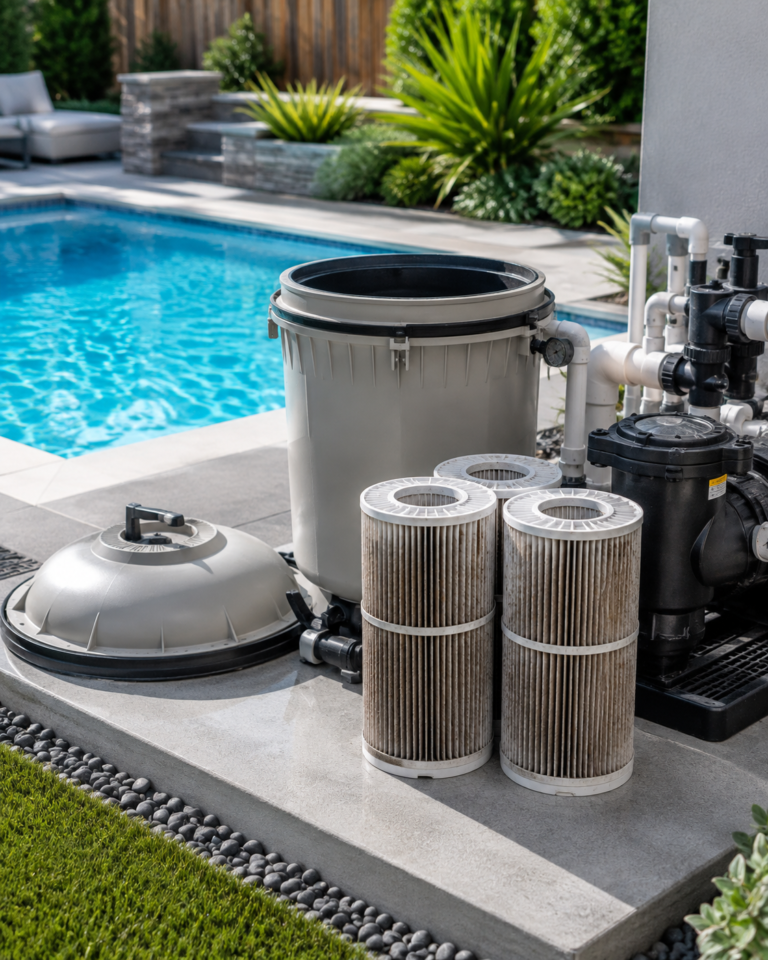
The swimming pool filter works with the pump and circulation system to remove suspended dirt and smaller particles from water moving through the equipment.
Larger debris is normally intercepted earlier by the pool skimmer basket, pump basket, cleaner bag, or leaf canister. As smaller material accumulates inside the filter, resistance through the filtration system can increase.
Filter cleaning is therefore one part of complete pool maintenance. It does not replace water testing, physical debris removal, basket cleaning, brushing, or routine circulation care.
Explore skimmer and pump basket cleaningThese symptoms can indicate filter loading, but they can also be caused by baskets, plumbing, pumps, valves, water level, chemistry, or other circulation conditions.
Pressure that has risen noticeably above the filter's established clean starting pressure may indicate that accumulated material is restricting water flow.
Reduced flow at the returns, skimmers, cleaners, or water features can occur when filtration becomes restricted.
Poor water clarity may involve filtration, although chemistry, algae, circulation, or suspended debris may also be responsible.
A filter that has operated through months of pool use, leaves, pollen, dust, and landscaping debris may require inspection and cleaning.
A filter can load much faster while removing treated algae, suspended dirt, and other material during a corrective pool cleanup.
Reduced circulation may affect automatic cleaners, attached spas, fountains, returns, and other components that depend on adequate water movement.
Compare the current pressure with the filter's known clean operating pressure and follow the cleaning guidance provided for the specific manufacturer and model.
Filter-cleaning procedures vary significantly according to the filtration system installed at your property.
Pleated cartridge elements collect dirt, oils, pollen, fine debris, and other suspended material as water passes through the filter.
Diatomaceous-earth filtration systems use D.E. media with internal grids or filter elements to capture fine suspended material.
Sand filters capture suspended material within the filter media and are normally maintained using the equipment's backwash and rinse functions.
The exact procedure depends on filter type, manufacturer, model, current condition, clean operating pressure, and whether components appear damaged.
The filter type, visible equipment condition, pressure, flow, and recent maintenance history can be reviewed before cleaning.
Current pressure may be compared with the known clean-filter pressure when that baseline is available.
Equipment must be safely shut down and pressure relieved before a pressurized filter housing is opened.
Removable filter cartridges or D.E. grids may be cleaned when applicable to the installed filtration system.
Accessible dirt and material accumulated inside an opened filter tank may be cleared when appropriate.
Sand and certain D.E. systems may use manufacturer-specified backwashing procedures rather than removable cartridges.
Accessible seals, O-rings, clamps, or closure components may be observed for obvious wear or damage when the equipment is opened.
Pressure and visible circulation may be observed again after service to identify whether additional issues appear to remain.
A filter housing should never be opened while the pump is running or while pressure remains trapped inside the system. Equipment should be serviced according to the manufacturer's safety procedure.
Cartridge-filter cleaning generally begins by safely shutting down and depressurizing the pool equipment before the filter housing is opened.
The cartridge elements may then be removed so accumulated dirt can be rinsed from the pleats. Accessible debris inside the tank can also be removed before the cartridges are reinstalled.
The elements should also be observed for deterioration, damaged pleats, broken bands, tears, collapsed sections, or other conditions that may mean cleaning alone is no longer appropriate.
A dirty but structurally intact cartridge may only need cleaning. Torn, deteriorated, cracked, or heavily deformed cartridges may need replacement rather than repeated cleaning.
D.E. filter maintenance depends on the particular equipment design and current condition. Routine service may involve backwashing, while more complete cleaning can require opening the filter and cleaning internal grids or elements.
Damaged grids, manifolds, seals, internal components, or other equipment issues may require repair or replacement rather than cleaning.
After applicable maintenance, the required filtration media must be restored according to the equipment manufacturer's specifications.
Backwashing can remove a portion of accumulated material, but some conditions call for opening the filter and cleaning the internal grids or elements more thoroughly.
Sand filters generally use a backwash cycle rather than removable cartridges. Water flow is redirected through the filter so accumulated material can be discharged to waste.
The equipment may then require the appropriate rinse cycle before returning the valve to normal filtration mode.
Persistent pressure, clarity, or flow problems after proper backwashing can indicate a valve, filter-media, plumbing, pump, or other equipment condition requiring additional evaluation.
Routine backwashing does not automatically mean the filter media needs replacement. Filter-media condition should be evaluated separately when problems continue.
There is no universal cleaning interval or pressure increase that applies to every swimming pool filter.
Filter size, model, surface area, pump speed, pool use, landscaping, algae history, weather, debris load, and local conditions can all affect how quickly the filter becomes loaded.
One useful reference is the filter's clean starting pressure. That is the pressure observed when the filter is clean and the pool equipment is operating normally at a known pump setting.
Instead of relying on a generic PSI threshold, compare future readings with your established clean pressure and the service recommendation for your exact filter model.
Leaves, pollen, dirt, grass, insects, and other material can increase the amount of debris eventually reaching the filter.
Explore basket cleaning →Treated algae and suspended organic material may significantly increase the amount of material the filter must capture.
Learn about green pool cleanup →Dirt and fine material disturbed from the floor can become suspended and eventually move into the filtration system.
Explore pool vacuuming →Sunscreen, body oils, dirt, organic material, and contaminants introduced through frequent use can increase filtration demand.
Wind-exposed properties and pools near landscaping can receive significant airborne material even when leaves are removed regularly.
Missed basket cleaning, vacuuming, water care, or filter service can allow debris and water-quality problems to accumulate.
Compare weekly maintenance plans →Green-pool recovery can place a much heavier load on a filter because treated algae, suspended organic matter, dirt, and other material must be removed as the water begins to clear.
During recovery, filter pressure and visible circulation may need to be monitored more closely than under ordinary maintenance conditions.
Depending on the filter type and the amount of material being collected, cleaning or backwashing may be required more frequently during the corrective process.
Learn about green pool cleanup and algae treatment →A clean filter cannot correct severely unbalanced pool chemistry, and balanced chemistry cannot physically remove dirt trapped inside an overloaded filter.
Explore Water Testing & Chemical BalancingClear water depends on filtration, circulation, debris removal, and appropriate water chemistry working together.
If the filter has been cleaned but the pool remains cloudy, dull, or algae-prone, the water may need additional testing and chemical evaluation.
Likewise, correcting chemistry will not remove accumulated dirt, oils, pollen, and fine debris physically trapped inside an overloaded filter.
Some filtration problems require damaged parts or equipment to be repaired or replaced rather than simply cleaned.
Torn, deteriorated, cracked, collapsed, or heavily deformed filter elements may no longer provide normal filtration after cleaning.
A damaged gauge, air-relief assembly, or related component may need separate replacement or repair.
Damage affecting the filter housing, clamp, lid, closure, or structural components should not be treated as an ordinary cleaning issue.
Continued poor circulation may involve the pump, plumbing, valves, baskets, suction lines, filter media, water level, or another equipment condition.
Provide the filter type, brand or model if known, current pressure, last cleaning date, and whether circulation or water clarity has changed.
Equipment details and photographs can help determine whether routine cleaning or another filter-related service may be needed.
The proposed work can be matched to the cartridge, D.E., or sand filtration system installed at the property.
Cleaning or maintenance is performed according to the confirmed scope and the requirements of the filtration system.
Damaged elements, valves, pumps, seals, pressure components, or persistent flow problems may require separate attention.
Pool filter cleaning prices vary according to the filtration system, filter size, internal configuration, current condition, debris load, accessibility, and whether additional components need attention.
Pricing can depend on the number and size of cartridges, current debris loading, equipment accessibility, and cartridge condition.
Request a condition-based quoteThe scope can vary depending on whether backwashing, grid cleaning, internal inspection, media replacement, or other maintenance is required.
Request a condition-based quoteRoutine backwashing may differ from deeper service involving valve, media, pressure, or persistent filtration problems.
Request a condition-based quoteHayward residential pools can receive pollen, dust, insects, leaves, grass, soil, and other landscaping material that eventually places additional load on the filtration system.
Properties near mature trees, gardens, hillside landscaping, or wind-exposed yards may experience faster accumulation of both large debris in the baskets and fine suspended material inside the filter.
Periods of missed maintenance, heavy pool use, green-water recovery, and seasonal debris may also cause a filter to load more quickly than under ordinary conditions.
Learn about skimmer and pump basket cleaning →Filtration needs should be based on the actual pool environment and filter condition rather than one rigid cleaning schedule.
Service is centered around Hayward and may extend to nearby East Bay communities depending on property location, route scheduling, filter type, service complexity, and provider availability.
Availability is not guaranteed in every listed community and may vary according to scheduling, travel distance, equipment requirements, and the service provider available for the requested work.
Filter-care recommendations for residential in-ground swimming pools using common filtration systems.
Cartridge, D.E., and sand filtration care can be combined with routine physical cleaning and water maintenance.
Saltwater pools still depend on physical filtration, pumps, baskets, circulation, and periodic filter maintenance.
Explore saltwater pool cleaningShared or related filtration systems may need to be reviewed when a swimming pool includes an attached spa.
Filters may require closer monitoring while removing treated algae and suspended material.
Explore green pool cleanupFiltration can be reviewed as part of restoring normal pool care after prolonged vacancy or delayed maintenance.
Explore one-time pool cleaning| Pool condition | Most relevant service | Explore |
|---|---|---|
| Dirty or overloaded pool filter | Cartridge, D.E., or sand filter cleaning | Pool Filter Cleaning |
| Full skimmer or pump baskets | Large debris removal from circulation baskets | Basket Cleaning |
| Leaves or dirt on the pool floor | Physical vacuuming and debris removal | Pool Vacuuming |
| Green water or visible algae | Corrective green-pool recovery | Green Pool Cleanup |
| Cloudy water or chemistry concerns | Water testing and condition-based balancing | Water Testing |
| Pool generally neglected | Broader one-time physical pool cleaning | One-Time Cleaning |
| Ongoing routine maintenance | Recurring physical cleaning and water care | Weekly Maintenance |
There is no universal interval for every filter. Filter type, model, size, landscaping, debris load, pool use, pump speed, algae history, and the manufacturer's pressure guidance all affect cleaning frequency.
Increased pressure compared with the established clean starting pressure, reduced circulation, visible dirt on the cartridges, or a known maintenance interval may indicate that cleaning is appropriate.
It can, but pressure can also be influenced by return restrictions, valves, plumbing, pump settings, filter media, and other circulation conditions. The reading should be compared with the pool's normal clean-filter pressure.
Restricted filtration can contribute to poor clarity, but cloudy water can also involve water chemistry, algae, circulation, suspended debris, or other maintenance conditions.
Water-related concerns may benefit from pool water testing and chemical balancing .
Poor filtration can contribute to conditions that make recovery more difficult, but green water generally requires a broader review of algae, sanitizer, chemistry, circulation, debris, and filtration.
Learn about green pool cleanup and algae treatment .
Standard cartridge filters are generally cleaned by safely opening the filter and removing and rinsing the cartridge elements rather than using a traditional sand-filter backwash process.
D.E. filtration systems generally require the appropriate filtration media to be restored according to the instructions for the specific filter after relevant cleaning or backwashing procedures.
No. Routine sand-filter cleaning generally uses the system's backwash and rinse functions. Persistent problems after backwashing may require a deeper inspection.
Filter service can be an important part of green-pool recovery because treated algae and suspended material may significantly increase filter loading.
Review our green pool cleanup service for related corrective care.
The exact inclusion depends on the maintenance plan and service provider. Routine weekly pool cleaning and complete filter disassembly or deep cleaning may be treated as different service scopes.
Compare our weekly pool cleaning and maintenance plans .
Pool filters operate under pressure. Homeowners should only perform equipment maintenance they understand and can complete safely. The pump must be off and the filtration system properly depressurized before a filter is opened.
Tell us what type of filter you have, the brand or model if known, the current pressure reading, normal clean pressure if available, when the filter was last serviced, and whether you have noticed reduced circulation, cloudy water, or green-water problems.